Showing posts with label Christian. Show all posts

Saturday, March 11, 2017

She Brought Forth her Firstborn (Diede alla Luce)

The second chapter of Luca, Luke, tells the story of the Birth of Christ. Specifically, Luca 2:7 tells us that Mary gave birth to, or brought forth, her firstborn son.

But if you read Luca 2:7 in an Italian version of the Bible, you won't see a literal translation of gave birth or brought forth. It says, diede alla luce.

This phrase literally means, she gave to the light, her firstborn son. What an awesome way to describe Christ's birth into this world. Now lest you think this is a specific way of describing the entrance of the Son of God into the world, let me point out that Luca 1:57 uses this same phrase, diede alla luce, when speaking of the birth of John the Baptist as well. In fact, this wording is used throughout the Italian version of the Bible and throughout Italy in general.


Saturday, February 25, 2017

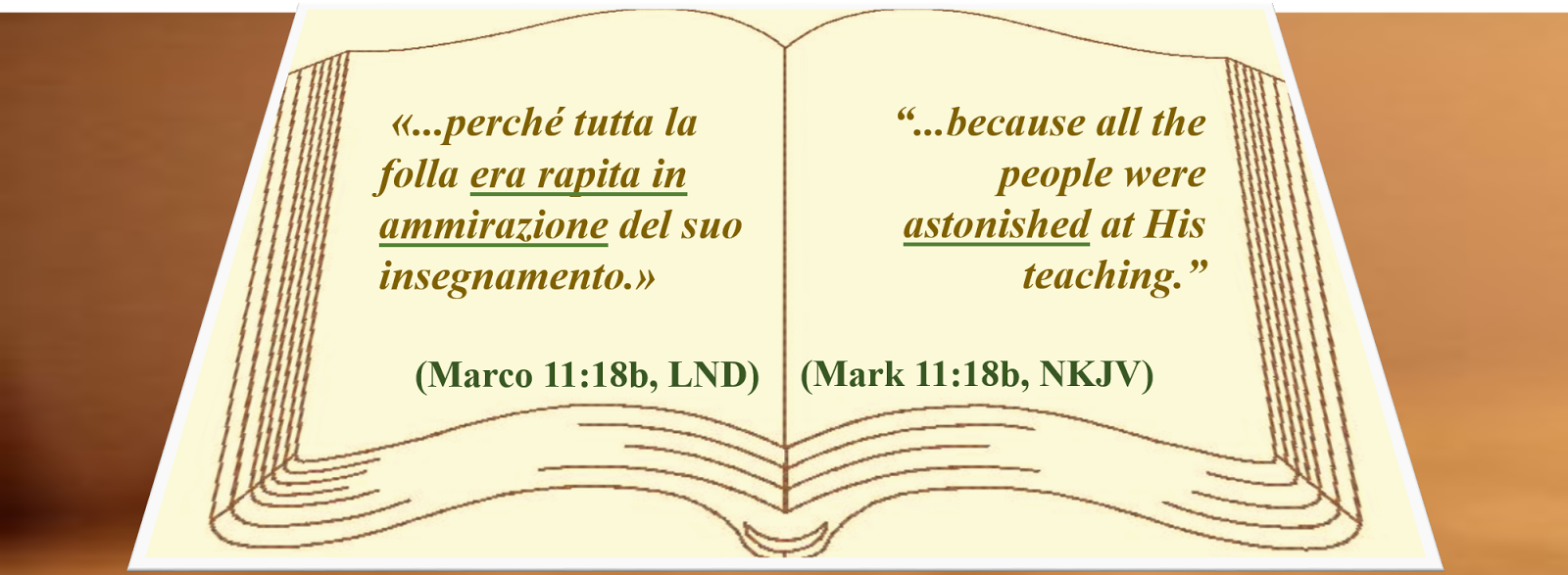
Astonished at His Teaching (Rapita in Ammirazione)


I don't know about you, but there are times when the Word of God fills me with such awe, that I can't find a way to fully express what it stirs up inside of me… But that doesn't stop me from trying.

So I really love the places where the Bible records the words of the people in reaction to something profound that Christ has spoken. This is what we see here in Marco, Mark 11:18. The English Bible uses the word astonished, saying the people were astonished at His teaching. Other ways of saying this would be amazed, enthusiastic, in admiration, or even spellbound. (I really like that last one.)
 
But after I read this in Italian, it brought me a step closer to being able to express what I often feel in response to God's Word.

In Italian, it says that the people, or the crowd, was rapita in ammirazione.

Rapita, can be translated here as captivated. It literally means kidnapped or taken captive. The words that Christ spoke were so profound that the people were taken captive by it.

But that's not all!

Saturday, February 4, 2017

Traded (A Farli Fruttare)


One of le parabole, the parables, in  Matthew 25 tells the story of a man who gave talents to his servants before going away on a trip.

This man gave five talents to one servant, two to another, and a single talent to a third. He gave each according to their ability. And once he was gone, the servants who received the five and the two talents went to work.

Now when the Bible talks about what the servant with the five talents did, the English version says he went and traded with them.

But the Italian from the Nuova Riveduta translation, uses the phrase a farli fruttare. Even if you don't fully understand this you can recognize  fruttare as a word similar to our English word fruit. The entire phrase literally means to make them yield, as a plant would yield fruit.

Saturday, January 28, 2017

You Made Them Equal to Us (Tu Li Hai Trattati Come Noi)

Matthew 20:1-16 tells una parabola, a parable, of a landowner who hired different men to work in his fields throughout the day. It ends with the teaching that the last (ultimi) will be first (primi), and the first last.

It's a truth that I've accepted because the Word of God says it, but I confess I didn't fully understand it. At least not until I read it as part of my daily Bible reading… in Italian! It's amazing how much of your understanding opens up just by reading in Italian day by day. And this time, it wasn't because of the words used in the Italian version. It was just because my understanding of the language is growing and I'm able to see more while reading in Italian because I don't have to work as hard to understand what the Italian is saying. I can just focus more on what God's word is saying and receiving insight and revelation from Him.

In this story, some workers are hired at the very beginning of the day and others at different times throughout the day, even at the eleventh hour, l'undicesima ora. Yet at the end of the day, they were all paid the same.

This bothered the workers who started at the beginning because they felt they should have been paid more than those who worked fewer hours. But the landowner reminded them that they received what he agreed to pay them. And also that it was his right to do whatever he wanted with what was his. Did his goodness bother them because there was something impure in their own hearts?

Saturday, January 21, 2017

My Yoke is Easy (Il mio giogo è dolce)

I remember a time when I'd become very weary of all that was going on in my life and greatly in need of God's rest, as it talks about in Matthew 11:28. We all get to this place at times; several times even. But let's be real. What Matthew 11:30 says it takes to get that rest, accepting that Christ's yoke is easy... just doesn't come easy. When you think of a yoke or a burden, it's something that you know you must bear, but is still difficult to endure. Yoke, easy. Burdens, light. These are pairs of words that don't seem to go together. And if you read the verse in the Italian, it takes this even further. In the Italian Bible, the word used for easy is dolce; which as many know means "sweet."

Can this really be true? Can a bitter trial we experience actually be sweet? Well getting back to the time when I was truly burdened, I felt like it was more than I could bear. Having already walked with Christ for some years, my prayer life had become pretty strong. But under the weight of my trial I found myself going to God in prayer even more. And as I did, something pretty amazing began to happen. I was spending a lot less of that time agonizing over my circumstances and a lot more in delightful fellowship with God. Right in the middle of my troubles!

I remember that this was also a lonely period in my life when no one really seemed to have time for me. There were days when I would literally stare at the phone hoping it would ring, and I'd have someone to talk to. But the truth was, part of my trial was learning how to walk alone, when necessary. And it was really the fact that I didn't have anyone to turn to as I went through this trial, that pushed me to spend more time in the presence of God.

And even though I didn't know anything about the Italian Bible at the time, looking back now I can truly say, that was when I had my first taste. Taste of what you might ask? My first taste of Christ's yoke being dolce, sweet.


Saturday, January 14, 2017

All These Things Will be Added (Vi Saranno Sopraggiunte)


I once saw an episode of a TV show where a man looked up one day and realized he was almost broke. Now usually that's the type of thing that  causes someone to panic. But this man didn't. And when asked repeatedly why he didn't; he gave pretty much the same answer each time. Something will come up, he'd say. Or, something will turn up.

The man wasn't worried because he knew that financially and career wise, he'd built on a good solid foundation. And he was confident that some opportunity would arise for him before things got too out of hand. And sure enough. By the time the show was over… out of the blue, something "came up."

The man's finances got back on track and he was able to continue having all the different things he needed.

In a similar way, Jesus teaches in Matthew 6 that we should not worry when there are unfulfilled needs in our lives. As it says in Matthew 6:33, if we are faithful in carrying out the things of God and we seek to walk in His righteousness; the things we're in need of will be supplied.

That's the way the English Bible puts it. It says, all these things will be added to us. But the word used in the Italian gives us another way of looking at this.

Saturday, January 7, 2017

You Shall Call His Name (Tu gli Porrai nome…)


I must confess. When growing up, I wasn't too crazy about my first name, Marcie. It wasn't the most common name and it seemed like most people I interacted with had a hard time saying it (at least at first). And forget about anyone spelling it right.

I use to imagine myself with a few other names I thought were more fitting. It wasn't a huge issue for me. I just would have preferred being called something else. That is until as a young Christian, I found out what my name meant… Warrior!

How awesome, I thought. All of a sudden, I liked my name; was proud of it. Even to this day when it seems like life is knocking me  around just a bit too much, I try to remember the name I've been given and remind myself that I can't get stuck being timid and fearful. I have to act more like my name. I have to put up a better fight.

Now I don't think that my parents intentionally picked a name for me that meant warrior. But over and over again in the Bible, we definitely see this happen. And with the opening chapter of the New Testament, we see God setting the stage for Christ's life and work on earth by telling Joseph what His name was to be before He was born.

"You shall call His name Jesus" (Matthew 1:21). That's powerful in and of itself.

But what made this stand out even more to me was the phrase used in the Italian language Bible, "gli porrai nome Gesù." The literal translation of this is more like, you shall put  or set upon him the name Jesus.

The Italian language is known for being a very expressive and colorful language that often describes things differently than many others. This is one of the reasons I've come to love reading the Bible in Italian. After being both a student and teacher of God's Word for more than 20 years, phrases and wording like this allow me to see the Scriptures in a whole new light. The phrase "tu gli porrai nome…" is a perfect example of this.

To say that a name is  placed or set upon a newborn child implies so much more than just something to identify him by. It's more like assigning a role, a calling or  even a destiny to someone. It reflects what or who he is to be.

The name set upon King David meant Beloved of God and we know that God thought of David as a man after his own heart. Before the birth of David's son who was to be the next king, God said his name was to be Solomon which means peace. And during King Solomon's reign, he indeed had a great time of peace.

Friday, December 23, 2016

A Plan for this One Year Journey, Pt. 3


1 Kings 4 tells the story of a married woman who was without child. But one day God's prophet Elisha announced to her that around this time next year she'd be holding a son in her arms.

About this time next year. Think of what that means.

For you and I, it means that within one year we can have something we've never had before. Some of us have never read through the whole Bible or even the New Testament in English; let alone in Italian. But now we're embarking on a journey to do just that.

And I like how it says, about this time next year, or in Italian, In questa stagione. That's in this season, next year.

Monday, December 19, 2016

A Plan for this One Year Journey, Pt. 1


Ital Bib Blog, 1 Ki Ch 6 V 38b With Background.jpg

You're Going to Need a Plan
One thing I've learned from other projects I've taken on, is that if I want to complete it successfully (or just complete it at all), I should have a plan. I Kings 6:38 tells us that Solomon was able to complete the building of the temple by following all the details of the plan that was mapped out ahead of time. I like the Italian word used here for plans, disegni.

It emphasizes the fact that our plans are really more like designs or blueprints.

So this is what I'm doing to help me complete my journey through the Italian New Testament in one year. I've developed a plan, or rather, a creative design, il disegnoto not just give me a schedule for reading, but also to help with the fact that I'm reading in another language; Italian. Likewise, you need to determine the plan, disegnothat suits you best. This post along with the next couple in this three-part series are designed to help you make that determination.


Things to Consider

  • You have to find an Italian version of the Bible. (Which Italian version will you be using?)
  • You'll need a quick and convenient way to find the English meaning of the words you don't know.
  • The number of days per week you'll be doing your readings
  • How much you'll have to read each day or how much time it will take you. (Keep in mind that you'll be reading in Italian.)
  • Will you be using an online Bible or Bible app? Or will you be using a printed Bible?
  • If an online Bible or app, does the plan/schedule have direct links to the required Scriptures for each day?
  • Is the plan/schedule you'll be using just for the New Testament, and for an entire  year?
  • Does it let you choose when you'll start or does it only start on January 1st?

None of these are big issues (other than making sure you have a Bible to read in Italian, of course). You can get started without having figured it all out and then put your plan in place as you go.


My Plan (and yours if you choose)
The plan that I will be following calls for 5 readings a week, 1 chapter each of those days. (Couldn't be simpler.)

The first week of reading begins with the week of Sunday, January 1, 2017.

You choose just five days of the week to read, e.g. Monday through Friday.

Week 1 Readings:
  • Matthew 1-5

Day 1 Reading:
  • Matthew 1

I will also be using a special computer setup of the Bible to read from each day. It's my own disegno that I created just for this journey. It shows the Italian and English translations for each chapter side by side.

This is the plan that's followed (and all setup for you), on the blog. So if you don't have a better setup, feel free to use this one.

Make Your Choice and Get Started Right Away
So having a plan will be a big help to you but more importantly for now, just get started. (Even if you're not starting at the same time that I am.) I hope you'll follow along by reading the NT for yourself. But at the very least, check out the weekly Bible posts. Either or both should help you increase your Bible knowledge as well as your Italian knowledge.

Look for parts 2 and 3 of this series for more direction and insight on how to prepare.


I can't wait to get started!